Did you know?
PDI can create custom Kelly bar adapters for Shaft Quantitative Inspection Device (SQUID) systems.
Diaphragm Walls/Barrettes – Testing of Irregularly Shaped Foundations
by Brent Robinson, P.E. and Mario Saavedra Msc.
Diaphragm walls—deep, narrow panels of reinforced concrete—are cast in situ using trench excavation techniques and often constructed in sequences with steel sections at each end to manage alignment and continuity. Given their shape and the buried environments in which they are installed, they are difficult to inspect once constructed.
Thermal Integrity Profiler (TIP™) utilizes the heat generated by cement hydration during concrete curing to detect anomalies. Sensors—typically placed vertically at 300 mm intervals along Thermal Wire® cables attached to the reinforcement cage—measure temperature at regular intervals through the curing process. These readings are stored and uploaded in real-time to PDI’s ATLAS™ Secure Cloud Services, allowing engineers to assess diaphragm wall integrity by analyzing temperature vs. depth profiles. Typical geometries require thermal wire cables to be installed in every corner of the diaphragm wall, and at no more than 1 meter distance along the wall faces.
Key anomalies identified through TIP include:
- Cooler zones, potentially indicating inclusions, voids, or insufficient concrete cover.
- Hotter zones, potentially suggesting bulges or overpour.
- Shifts in the reinforcing cage, indicated by temperature asymmetry between thermal wire cables placed on opposite sides of the cage.
This article summarizes three recent examples that explore the application of TIP to diaphragm walls and barrettes.
Research Spotlight: Thermal Modeling and Field Data Integration1
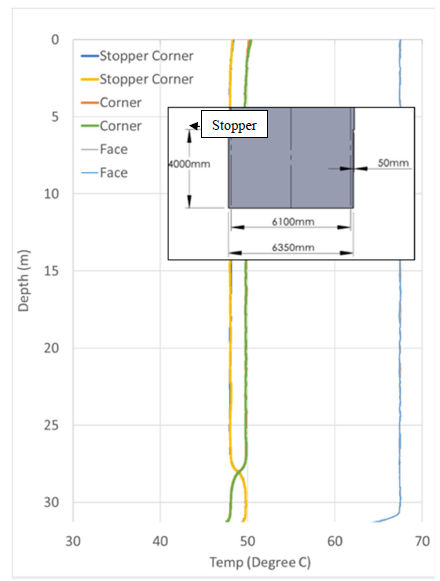
In this study, we modeled heat generation in a 6.4 m x 1.2 m x 32 m diaphragm wall using COMSOL Multiphysics. The analysis predicted how temperature would be distributed across a rectangular cage centered in uniform concrete. Corners, having higher surface area contact with soil, were consistently cooler than wires on the wall faces. This served as a baseline for interpreting field data.
Twelve Thermal Wire® cables were attached to a real-world panel, and the resulting data generally followed the model predictions—except for a curious asymmetry in the corners near the panel’s base. Temperatures on one set of corner wires decreased more rapidly from 28 m to 32 m, suggesting a localized inclusion or geometry change.
Further investigation revealed that a 50 mm steel stopper had been used during construction, shifting the effective shape of the wall below 28 m. When this detail was included in the model, the simulated temperature trends aligned with field data. The study showed TIP’s value not just in identifying anomalies, but in identifying geometric changes introduced during construction that affected cover but not the volume of concrete placed.

Case Study: Integrity Assessment in Bengaluru2
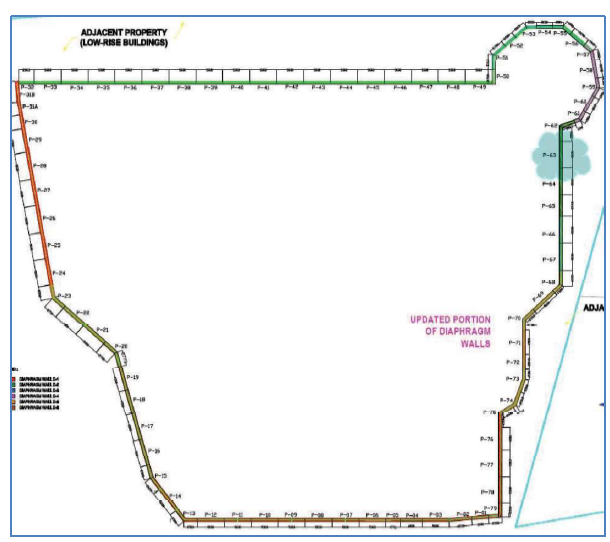
A project in Bengaluru involved construction of diaphragm walls for a 20-story residential building adjacent to a water body. A 0.6 m wide, 5.0 m long, 17.8 m deep primary panel, was selected for testing using thermal integrity profiling. Ten thermal wire cables, each with sensors spaced at ~300 mm (1 foot), were installed along the length of the diaphragm reinforcing cage.

Real-time data was collected every 15 minutes using thermal acquisition ports (TAP-Edge), continuing until peak hydration temperatures were identified by online review in ATLAS™, about 27 hours post-pour. Interpretation of this data revealed:
- Temperature reductions from 15–17.8 m at corner wires, suggesting soft bottom conditions or potential debris pushed to the corners while pumping concrete.
- Localized temperature increases from 2–6 m and 11–13 m, likely due to bulging or overpour—consistent with a measured 10.5% excess concrete volume, and local small temperature reductions at the location of post-excavation anchor access ducts.
- Slight misalignments in cage position, observed by comparing opposite wire cable temperatures.
While these anomalies were mostly minor and localized, their detection affirmed the value of TIP in validating construction quality and offering early corrective insights. Adjacent panel analysis was recommended to further confirm interpretations.
-1.jpeg)
Case Study: Paraguay’s First TIP Project on Barrettes
In Asunción, Paraguay, the construction of Paseo 55—a 55-story residential tower and future architectural landmark—marked the country’s first use of TIP. The project featured barrette piles up to 40 meters deep. Due to the constrained site, barrettes were chosen for easier access, and TIP was deployed on 50% of them.
PDI prepared and installed the first set of Thermal Wire® cables, analyzed TIP data, and provided real-time cloud-integrated initial interpretation and reporting. Each barrette used eight thermal wire cables.
TIP provided a qualitative assessment of concrete quantity and quality. Consistent heat dispersion across the barrettes' long faces and predictably cooler zones at the corners suggested no local anomalies, and only minor cage misalignments.
The project used ~7 km of thermal wire cables, and TIP delivered integrity results within 30–40 hours— faster than traditional CSL testing. The efficiency of TIP enabled swift decision-making and kept the foundation program on schedule, while addressing foundation integrity.
TIP testing of irregularly shaped, cast-in-place foundation elements such as diaphragm walls and barrettes provides real-time remote monitoring with ATLAS™ Cloud Services, allowing for proactive decision-making and non-intrusive testing. TIP testing also provides high-resolution data, capable of detecting localized defects and misalignments much earlier than other available integrity test methods.

Anthony McFarland, former intern of GRL Engineers, joined the Central office as a staff engineer. Anthony received his Bachelor of Civil Engineering from Cleveland State University in Cleveland, Ohio. During his internship, he revised AutoCAD drawings for GRL Cells, updated equipment manuals and managed inventory for TIP systems.

Brian Ayala joined the GRL Illinois office as a Staff Engineer. Brian received his Bachelor of Science in Civil Engineering from Olivet Nazarene University in Bourbonnais, Illinois. He has experience in construction management, project scheduling and site inspections.

Sandesh Pokharel joined the GRL Illinois office as a Staff Engineer. Sandesh received his Master of Science and Civil Engineering from Southern Illinois University Edwardsville, in Edwardsville, Illinois. He has experience in geotechnical engineering including field logging, soil classification, borhole logs and reviewing geotechnical data.
Conference: SEI Electrical Transmission & Substation Structures Conference
September 14-18, 2025 - Dallas, TX - Booth #1216
Learn More
Conference: Southeastern Transportation and Geotechnical Engineering Conference
September 15-18, 2025 - Williamsburg, VA - Booth #4
Learn More

Seminar: Deep Foundation Integrity Testing & Wave Equation Analysis
October 15, 2025 - Cleveland, OH
Register Now
Workshop: High Strain Dynamic Testing & Proficiency Test Option
October 16-17, 2025 - Cleveland, OH
Register Now


Workshop: PDCA The Driven Pile Academy
November 10-14, 2025 - Port Beinville, Mississippi
Register Now
Conference: Transmission & Distribution Conference 2025
November 11-12, 2025 - Orlando, FL - Booth #331
Learn More