Did you know?
GRL Engineers was incorporated 50 years ago as a consulting practice providing a service based on the Case Method, utilizing the Pile Driving Analyzer® (PDA).
BDSLT Techniques to Corroborate High Drilled Shaft Unit Resistances
by Jon Sinnreich, P.E. and Glenn Santulli, P.E.
Typically, Bi-Directional Static Load Testing (BDSLT) is utilized to assess the bearing capacity of a drilled shaft. To obtain the full bearing capacity, the location of the jack assembly must be positioned at the resistance balance point where equal geotechnical resistance occurs above and below the embedded jack location. Mobilized shaft and base resistances from the test are used to develop an estimated equivalent top-down load-settlement plot.
In specific circumstances, the design engineer may need to check that a specific unit shaft resistance is obtainable as in the case where the design relies on only rock socket frictional resistance with both the shaft resistance in the overlying soil and the base resistance disregarded. Alternatively, when a shaft is advanced through thin or weak overburden materials onto very competent rock, the design may rely solely on base resistance. In this case, the attainable unit base resistance needs to be determined. This article highlights the use of BDSLT as an economical testing method to validate challenging designs with high unit shaft or unit base resistances.
Tests to Determine High Rock Socket Unit Resistances
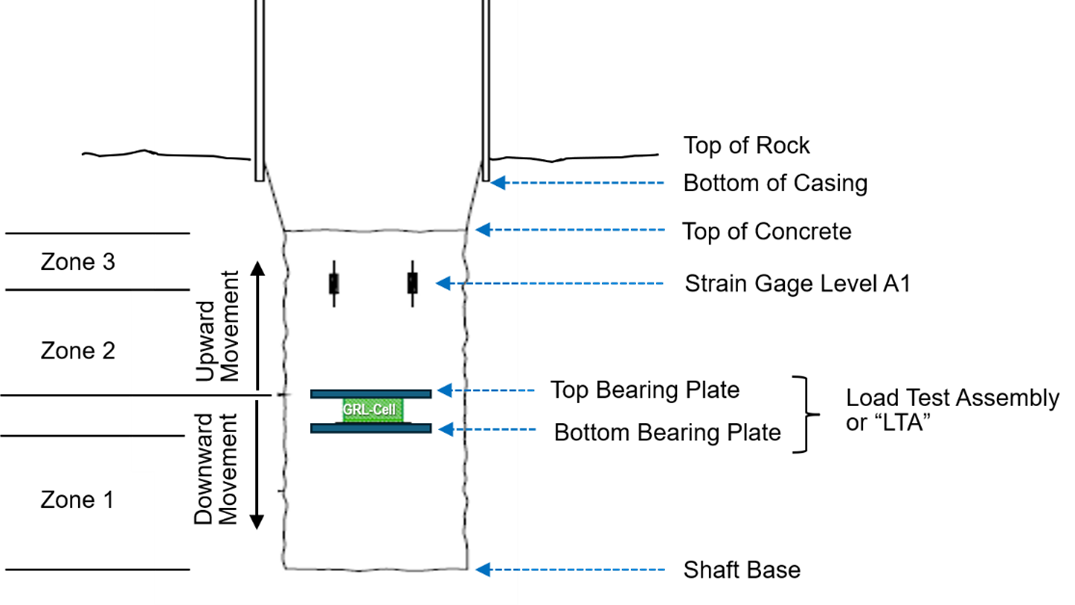
To check for high rock socket frictional resistance, the test is designed with the GRL-Cell positioned a relatively short distance below the top of the rock socket. Concrete is placed only in the rock socket, as illustrated in Figure 1, to eliminate load transfer to the overlying materials. Strain gages are cast into the concrete for insight into the load shed in the rock socket. If rock quality is in question near the top of the rock layer, placing the strain gage level slightly below this zone will allow for the differentiation between weaker and competent rock. In a short rock socket, one strain gage level above the GRL-Cell is often sufficient.

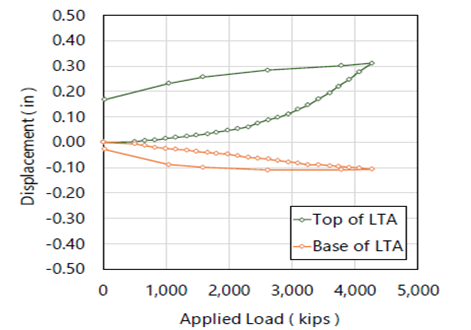
For this rock socket assessment test, a plot of the applied load vs displacement curves of the top and bottom bearing plates of the Load Test Assembly (LTA) is presented in Figure 2.

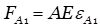
The measured strains at strain gage level A1 are converted to the internal force, FA1 using Equation 1. Several methods (1, 2) are available to determine the foundation’s rigidity, AE, at the strain gage level. An improved assessment of the cross-sectional area, A, of the rock socket at the strain gage location is frequently obtained by using Thermal Integrity Profiling cables in conjunction with the concrete pour volume records. This approach leads to higher reliability on the unit rock socket resistance values.
Equation 1
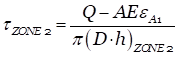
The unit rock socket resistance in zone2, τzone2, is computed from the difference between the applied upward GRL-Cell load above the LTA, Q, and the calculated internal force from the measured strain at strain gage level A1 divided by the rock socket shear area in zone2. The rock socket shear area is calculated from the rock socket diameter, D, multiplied by the height, h, of zone 2.
Equation 2
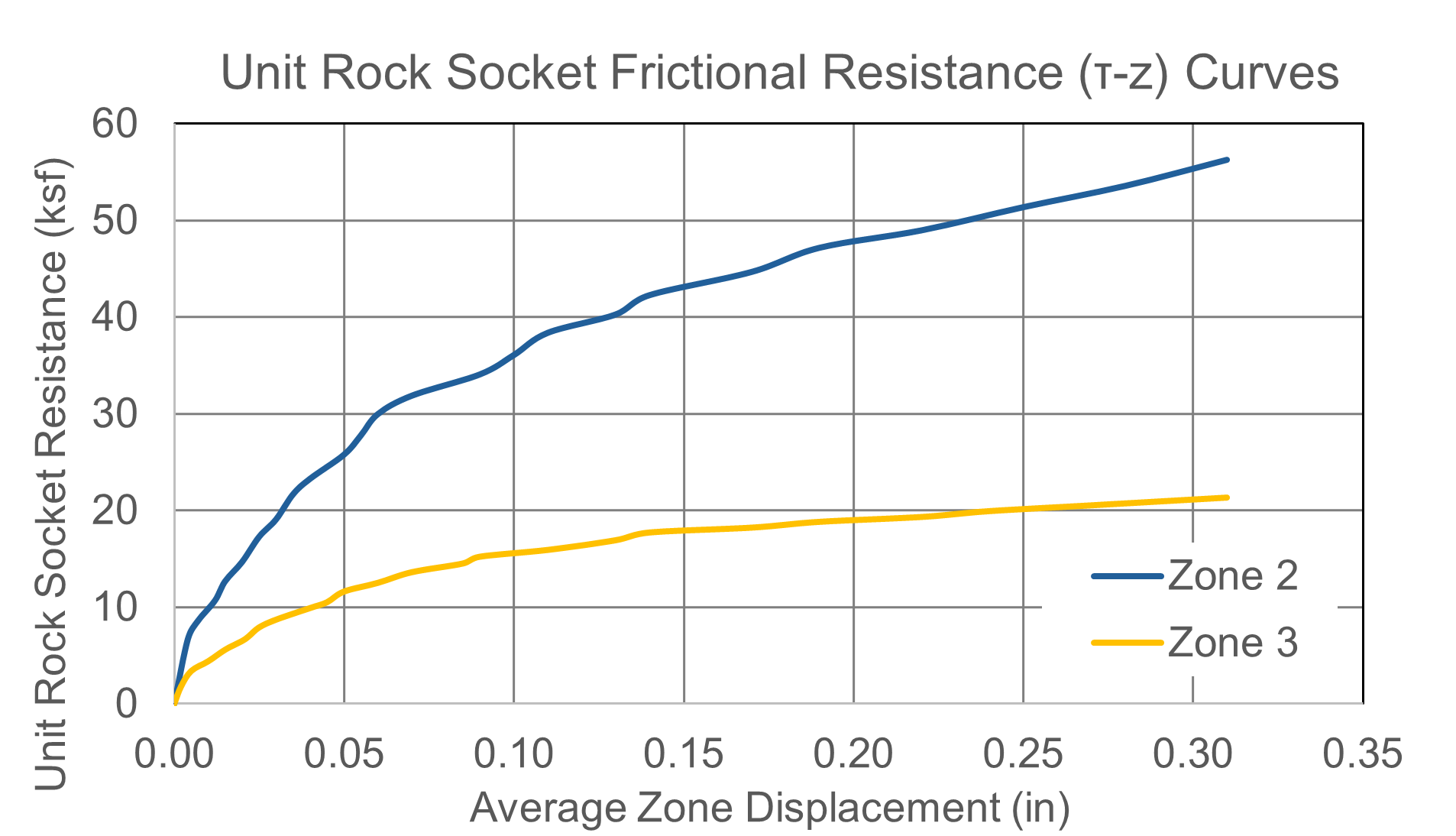
These computations can be repeated for Zone 3 with using the top of concrete as the “zero shear” elevation and all remaining load shed taking place above SG Level A1. The unit side shear versus segmental displacements for each of the shear zones (the so-called “t‑z” curves) are plotted and presented in Figure 3.
Tests to Determine High Unit Base Resistances
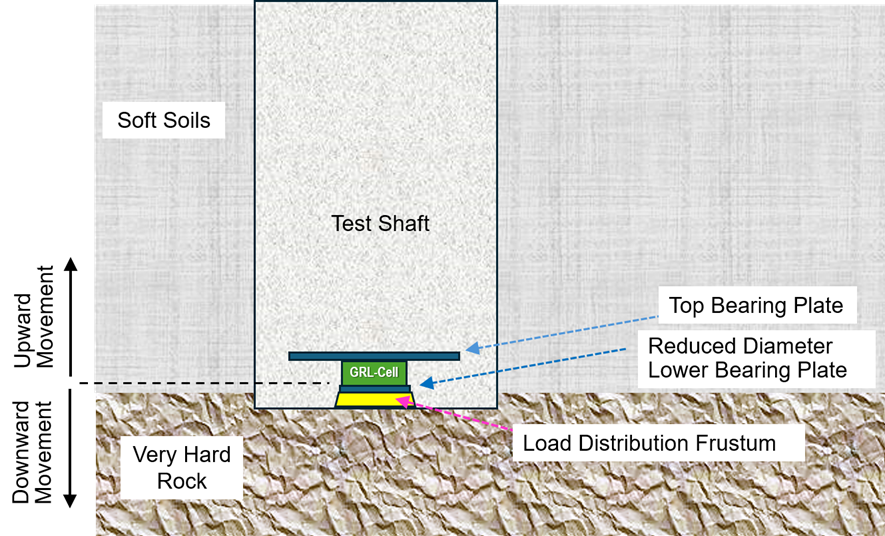
Soft or thin surficial deposits overlying hard rocks occur in many areas. As noted earlier, drilled shafts are often designed for high base resistances on these very competent rocks. The available shaft resistance in these cases is often insufficient to prevent a BDSLT from failing quickly upward due to the low magnitude of resisting shaft resistance. In these cases, the BDSLT can be designed with the LTA close to the base (typically within 6 inches or 150 mm, designated as height h). A reduced-diameter lower bearing plate is designed so that only a portion of the base area is loaded. The bearing plate diameter is determined based on the rock strength as well as the shaft resistance available above the LTA. This reduced-area test of unit base resistance is sometimes referred to as the “Chicago Method” and is recognized by the FHWA (3).
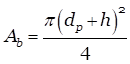
The frustum of stressed concrete beneath the lower bearing plate is assumed to have a slope of 2V:1H, so the actual stressed area, Ab, beneath the LTA bearing plate of diameter dp is computed as:
Equation 3
The unit base resistance computed from the reduced base area is then scaled up across the full base area to estimate the full base resistance force. An example of a Chicago Method test arrangement in presented in Figure 4.
Based on the theory of elasticity, the settlement z of a rigid disk of diameter d subject to a uniform pressure q and fully embedded in an elastic medium which has a Young’s modulus E and Poisson’s ratio ν is given by:
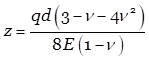
Equation 4
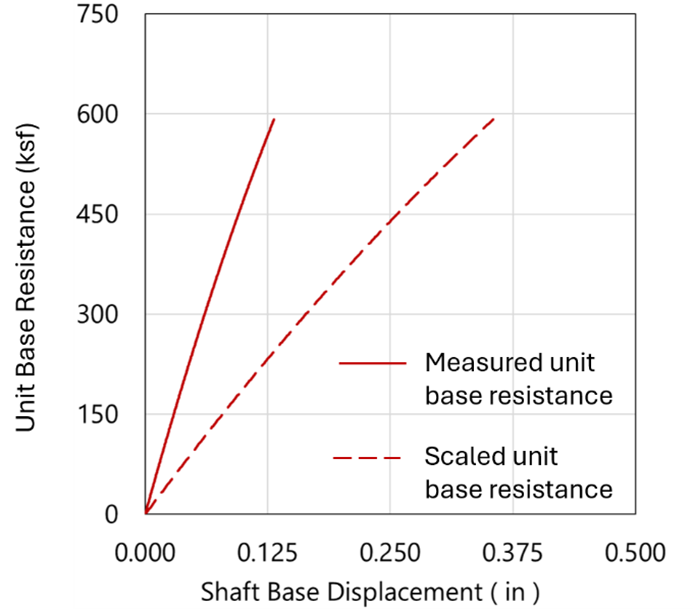
Although the actual base resistance load-displacement curve is typically not purely linear‑elastic, the simple analysis given by Equation 4 suggests that for a given settlement, an inverse relationship between q and d exists. The measured unit base resistance curve is therefore scaled up by increasing the settlement z at a given pressure q by the ratio of D/(dp+h) (shaft diameter/stress disk diameter):
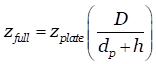
Equation 5
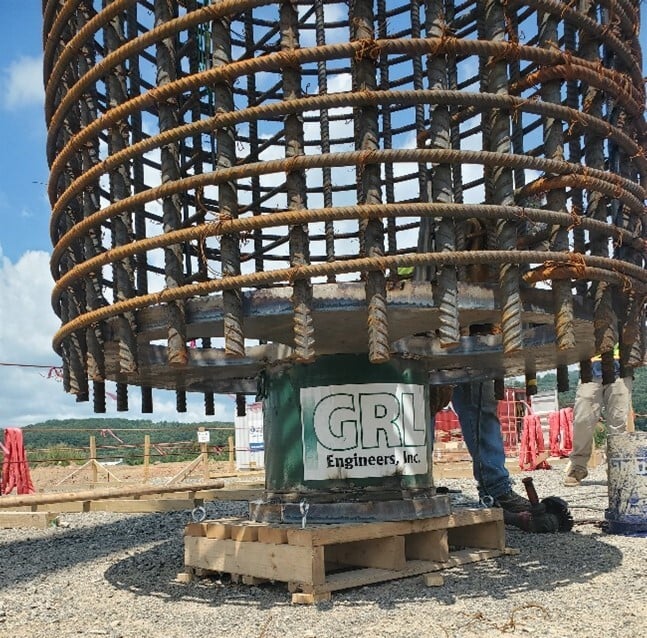
GRL Engineers have designed several bi-directional load tests using the Chicago Method on projects where site geotechnical conditions and foundation loading required this approach. A recent example involved 6.5-foot (2 meter) diameter by approximately 25 ft long (7.6 m) drilled shafts to hard rock. A test load of 15,000 kips (66.7 MN) was requested by the engineer. Because of the short socket length, it was not possible to develop 7,500 kips (33.4 MN) in upward resistance to balance the bi-directional test. Therefore, a 20-inch (51 cm) diameter GRL-Cell was utilized on a 24-inch (61 cm) diameter lower bearing plate, installed 4 inches (10 cm) above the shaft base. The LTA configuration designed for this Chicago Method test is shown in Figure 5.

A maximum load of over 2,500 kips (11.1 MN) was applied to the 28-inch (71 cm) diameter stressed area. As illustrated in Figure 6, this demonstrated a unit base resistance of almost 600 ksf (28.7 MPa) at a displacement of approximately ⅛ inch (3.2 mm).

The calculated displacement for that unit base resistance when scaled over the full base area using Equation 5 is still less than ⅜ inch (9.5 mm). The unit base resistance, scaled up across the full base diameter, corresponds to a base resistance of over 18,000 kips (80.1 MN) from the bi-directional load test conducted using a single 2,200-kip (9.8 MN) capacity GRL-Cell.
Summary
Presented examples illustrate how bi-directional load testing can still be used for design corroboration in challenging stratigraphy and loading conditions. In both presented cases, good QA/QC procedures were very beneficial to test interpretation. TIP results in both cases indicated larger constructed shaft diameters than designed and no integrity issues. In the high unit base resistance case, the shaft excavation was also profiled with a SHAPE system. Those results agreed with the TIP results that the constructed shaft diameter was larger than designed.
References:
- Fellenius, B.H., 2001. From Strain Measurements to Load in an Instrumented Pile. Geotechnical News, Vol. 19, Issue 1, pp35-38
- Komurka, V.E. and Robertson, S., 2020. Results and Lessons Learned from Converting Strain to Internal Force in Instrumented Static Loading Tests Using the Incremental Rigidity Method, Proceedings of ASCE Geo-Congress 2020, Minneapolis, MN pp 135-152
- FHWA, 2018. Drilled Shafts: Construction Procedures and Design Methods (GEC10 Drilled Shafts Manual), Publication No. FHWA-NHI 18-024
Pile Dynamics, Inc and GRL Engineers are hosting one-day seminars covering the Benefits, Methods, Interpretations, Risks and Implementations of Quality Control Practices for the deep foundations industry.
The State of Practice Seminars are intended for designers, specifiers, contractors, owners, and others involved in deep foundations looking to optimize design, construction time, and project cost. Case studies of projects localized to each market will be discussed.
6.5 Professional Development Hours will be provided per registrant. Your registration fee includes all presentation materials, breakfast, lunch and parking
AGENDA
• Overview of the Benefits of Testing
• Method Selection
• How to Implement Testing into a Project
• Understanding Test Methods and Results
• Illustrative Examples
• Advantages and Limitations
• Risk Mitigation
• Case Histories
• Testing Solutions Benefits & Cost Savings
Upcoming Dates & Locations:
9/14/26 - Atlanta, GA
9/16/26 - Philadelphia, PA
9/18/26 - New York City, NY
10/12/26 - Houston, TX
10/14/26 - Mobile, AL
10/16/26 - St. Louis, MO

PDI Welcomes Amine Bourahli
Webinar: Engineering Considerations for the Proper Evaluation and Effective Use of Pile Static and Dynamic Testing Results
June 11, 2026 - Online
Learn More


Conference: 14th European Conference on Non-Destructive Testing
June 15-19, 2026 - Verona, Italy - Booth 304
Learn More


Meeting: AASHTO Bridges and Structures 2026 Annual Meeting
June 28 - July 2, 2026 - Charlotte, NC
Learn More


Conference: DFI S3 Slopes, Support & Stabilization
August 11-13, 2026 - Charlotte, NC - Booth 102
Learn More


Conference: 55th Annual Southeastern Transportation Geotechnical Engineering Conference
August 31 - September 3, 2026 - Biloxi, MS - Booth 39
Learn More

Conference: 79th Canadian Geotechnical Conference GeoQuebec
September 12-16, 2026 - Quebec, Canada
Register Now